
 Rails to Trails out of Washington, D.C. is recruiting 20,000 people to pledge to walk and bike more this year and use their vehicle less this year. Horizons communities around the state have identified actions to address poverty in their community. Many have identified our cultural reliance upon personal vehicles as an impediment to thriving communities. There is little public transport in rural areas and safe-bike ways are forgotten. Rails-to-Trails is an organization that has addressed this concern positively around the country, including in some of the Horizons communities. Take the pledge to support the effort to reduce our reliance upon oil and to build healthier communities where people are at the center. Visit their website to take the pledge.
Category: Horizons Program
Rutland’s Vision
A “Vision Statement and Strategic Plan” was developed for Rutland using the collated input from the Study Circles, Community forums and other Horizon work during the year. The Vision Statement is shown below and future blog segments will address where we are in working on each of the goals and strategies.
GOAL 1: Volunteers will be the driving force in providing services and activities that would otherwise not be available in a community the size of Rutland. Those currently active in the community will invite and encourage individuals of all ages not currently active, to engage in leadership roles and will be open to the new ideas these new volunteers bring to the table.
| STRATEGIES | RESPONSIBILITY | BY | EVALUATION |
| Appoint two (2) Volunteer Coordinators to coordinate service needs and match with volunteer interests, abilities and availability. | Horizons Steering Committee | June 1, 2008 | Volunteer Coordinators appointed and services are coordinated with Seniors, the Senior Center, and volunteers to provide needed services. |
GOAL 2: Rutland will be a clean and inviting community in which to live and work
| STRATEGIES | RESPONSIBILITY | BY | EVALUATION |
| “Clean Up/Help your Neighbor Day” will be held | Volunteer Coordinators; all able-bodied community members | September 30, 2008 | Trees are trimmed, yards and debris cleaned up, minor repairs are made. |
| Remove or renovate substandard buildings | Building owners, City Council | January 2010 | Buildings are improved or demolished |
| Repair and replace sidewalks | City, Property Owners | January 2009 | Sidewalks are repaired or replaced on a regular cycle to ensure safe pathways for visitors, Seniors, youths |
| Establish a Renaissance Zone | City, Renaissance Zone Committee | January 2009 | A Renaissance Zone is created for future development and funding possibilities |
| Install a “Welcome to Rutland Sign” or move burger to outskirts | City, Community Club | October 2008 | Sign is installed near highway to draw passing motorists |
GOAL 3: Rutland’s economy will expand and diversify providing a thriving Main Street, while retaining existing business and services. Tourism will be a significant area for economic growth.
| STRATEGIES | RESPONSIBILITY | BY | EVALUATION |
| Upgrade and maintain current commercial infrastructure | City, Business Owners | December 2008 | Infrastructure improvement plan is developed and guidelines established for ongoing physical plant maintenance |
| Identify potential community amenities for a tourism publicity campaign | Horizons Advertising Committee | Spring 2008; ongoing | Publicity draws increased tourism |
| Explore possible niches and incentives for new business | Rutland CDC | Start in 2008; ongoing | Needed businesses and available incentives will be identified |
| Explore the feasibility for a new business “incubator” | City, private investors, Rutland CDC | December 2012 | Incubator potential explored; report presented on pursuing project or identifying alternatives to draw new business |
| Develop an advertising program for needed services/businesses | Community Club, RCDC, Advertising Committee | June 2009 | Targeted advertising program is developed and publicity appears in local, regional and national publications |
| Identify potential routes for a hiking/biking trail | Hiking/Biking Trail Committee | 2010 | Potential trail routes are identified along with possible funding sources |
| Identify potential funding sources for projects | City, Advertising Committee, Hiking/Biking Trail Committee | June 2008; ongoing | Funding sources are identified and applications submitted for various projects |
GOAL 4: Rutland will have appropriate housing and services for disabled and elderly with the goal of keeping that population in the community.
| STRATEGIES | RESPONSIBILITY | BY | EVALUATION |
| Provide improved handicap accessibility in current apartments | Housing Association, Horizons Housing Group | 2017 | Current apartments are handicap accessible. |
| Build housing specifically for elderly and disabled | Rutland Housing Authority, Rutland Housing Inc., Private investors | 2017 | One- level housing has been built with walk-in showers, lever door handles and other handicap appropriate devices. |
| Provide improved mobility for seniors | Volunteer Coordinators, Senior Center, Community Club | Increased mobility is provided through volunteer efforts or through existing services such as Sargent County Health Services | |
| Identify potential funding sources for projects | Horizons Housing Group, Rutland Housing Authority | June 2008; ongoing | Funding sources are identified and applications submitted for various projects |
GOAL 5: Rutland will provide a recreational program addressing the social, educational and cultural needs of all age groups.
| STRATEGIES | RESPONSIBILITY | BY | EVALUATION |
| Develop a recreational program for the entire community | Park Board, Rec/Community Center Committee, Community Club | Immediately; ongoing | Activities are regularly occurring in the community for all age groups. |
| Provide better management oversight and fuller use of existing infrastructure | Facility owners, Community Club, Park Board, City | December 31, 2008 | Existing infrastructure is available and utilized more for community needs and services |
| A multi-use building will be available for recreational and educational purposes. | Facility owners, Community Club, Park Board | 2015 | A multi-use building is available – either through existing or new |
| Identify potential funding sources for projects | Park Board, Rec/Community Center Committee, Community Club, City | Funding sources are identified and applications submitted for various projects |
Hosting NDSU Bus Tour
 I
I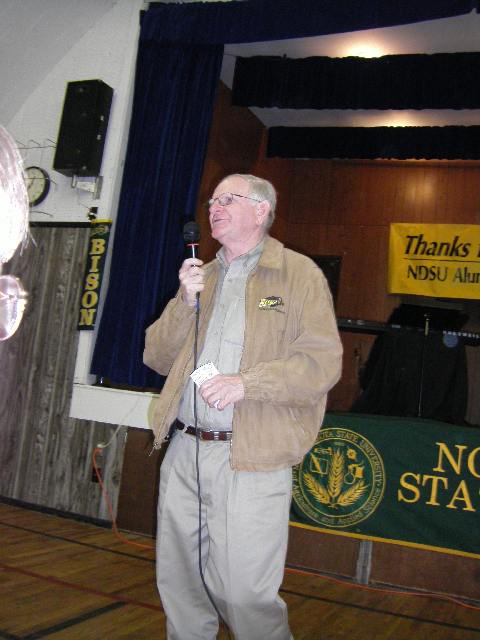
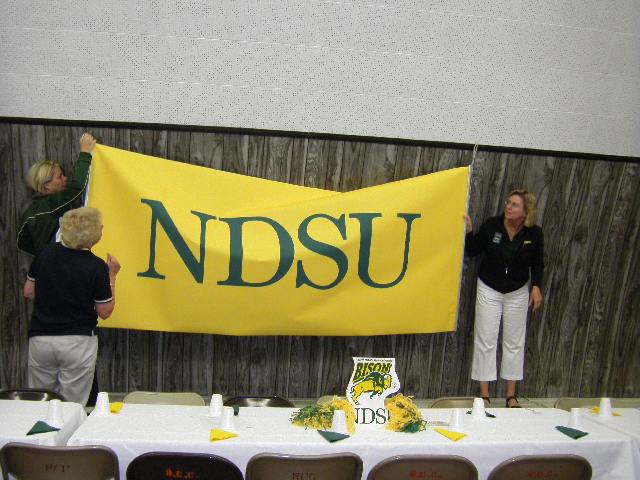
 It was green and gold everywhere when people stepped into the Rutland City Hall about 11:00 a.m. on Tuesday. A team was preparing for the NDSU Bus Tour which was going to arrive a little before noon. Carolyn Christensen had been asked to be one of the hosts and Stan and Betty Melroe, and Steve and Sheila Wyum, put finishing touches on the decorations.
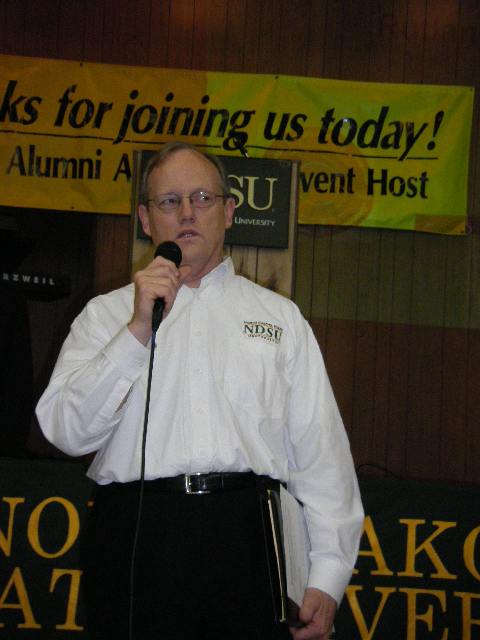
Four of NDSU’s coaches arrived (Tod Brown, head baseball; Don Larson, head men’s track; Darren Mueller, head softball and Saul Phillips (head men’s basketball) and the hosts had the opportunity to visit with them before the big bus arrived. The bus arrived on time and the hosts were kept busy meetin’ and greetin’. The decibal level in the room increased dramatically as people visited with each other.
Everyone seemed to enjoy the meal that was provided by the Rutland General Store and the Rutland Cafe. Even though I was hungry and the food tasted good, I was a little nervous about my presentation and wasn’t able to finish my food.
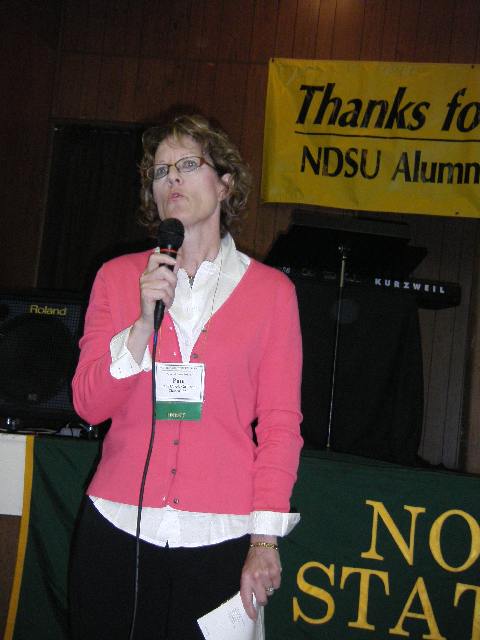
DC Coston emceed the short program. Pam Gulleson, our local legislator in the House of Representatives, introduced President Joe Chapman. He had all the NDSU staff introduce themselves and he talked about NDSU’s progress and future goals. Saul Phillips spoke about being in Division I and how excited he is to be a part of a progressive university such as NDSU. Then DC introduced Deborah Banish and Carolyn Christensen who made a brief presentation on Rutland’s involvement with the Horizons Program. Deb developed the power point that was used and it was super. If we were good, it was thanks to her skill with the computer.
After a short stop to check out the Rutland General Store and some picture taking, the bus left on time for a tour of Dakota Micro near Geneseo and then on to the Bagg Farm for pie.
A lot was packed into the time frame of 11:40 to 1:40, but I am confident that everyone who was here with the NDSU entourage felt welcome and left with a positive image of Rutland.
Rutland’s Story
Rutland’s journey with the Horizon Program began when seven people attended the Horizon Showcase in Wahpeton. That seven multiplied to include nearly the entire Rutland community involved in some aspect of Horizon.
Study Circles, LeadershipPlenty and community forums provided opportunities for residents to express concerns. It also forced Rutland residents to identify the community’s key assets and determine how we could harness those assets to make Rutland a better community for everyone. There is now a better attitude about Rutland’s future. People are thinking more about “What else can we do?” instead of waiting for the inevitable death of a once vital community. We have become more proactive, rather than simply being reactive.
From the Study Circles, LeadershipPlenty and community forums came four action plans that were voted on by the community. Those plans include developing an advertising program and strategy, organizing a community recreation program, determining housing needs and establishing a hiking/biking trail from Rutland to Silver Lake. The committees for these plans have met and are working on ways to implement these plans.
The Horizon Program has definitely made more residents aware of the lack of handicap accessibility in local apartment buildings, it has made organizations more aggressive in fund raising efforts to obtain needed equipment and services and perhaps, most importantly, has gotten more people involved in city government and interested in running for election.
Partnering has been an important lesson learned from the Horizon Program. It has helped organizations pool their resources instead of trying to keep others from getting any of the pot. It wasn’t always easy, but it is happening. An example is the opening of the Fitness Center in the American Legion building. Legion members were not completely supportive of this arrangement, but they have discovered that it has been a good decision. The Fitness Center has made improvements to the facility and is paying the utilities for the building. The Fitness Center is being used by males and females from ages 15 to 85. Some of the members participate in the aerobics classes held twice a week in City Hall, sponsored by the Rutland Fitness Center.
Another partnership is the Senior Citizen Center with the Community Club. Each Sunday, the Community Club sponsors Bingo in the Senior Citizen Center. The rent that the Community Club pays for the use of the building has helped the Senior Citizens with their expenses. Youth are involved in calling Bingo and helping to sell pop and snacks. Bingo players range from 3 to 83 with a good turnout each week.
Residents seemed to have little if no interest in the city government operations and it was something that they had no control over prior to Horizon. We now have more people going to City Council meetings and we have new people who are willing to serve in an office. It will be interesting to see the June election results where the incumbents will actually have people running against them – something that has not occurred for nearly a century.
A new Rutland Comprehensive Plan and a new zoning ordinance have been created as a result of more people being involved in guiding the future of the City. A new Zoning Board was appointed and they met with the Housing Committee and the Renaissance Zone Committee to update the two items. The City Council adopted the new Ordinance and the Comprehensive Plan which will serve as the basis for Rutland ’s Renaissance Zone application. The community is excited about the possibilities for the future of Rutland with the establishment of the Renaissance Zone.
Rutland has had several young men become involved in the Rutland/Cayuga Fire Department. They have energized that organization to become a better equipped department by soliciting grant funds and spearheading fundraisers, such as an Easter brunch that drew 250 people.
The resurgence of Fun Night has given everyone in the community something to look forward to after the busyness of harvest. New people involved in planning Santa Day expanded it from a day only for children to involve activities for people of all ages.
A young couple who enjoy dancing began Dance Night at the city hall the first and third Sundays of the month. A variety of CD music provides waltzes, polkas, two steps and jitterbugging. For two dollars a person, dance lovers can trip the light fantastic for a couple of hours.
The Horizon Program has definitely been a positive experience for Rutland. It has been a catalyst for people to dare to try new things, to become more involved, and, most importantly, to believe that Rutland can once again be a vibrant community. The foundation has been laid and is ready for the building.
Horizons Books and Resources
NDSU Extension Service, Center for Community Vitality has provided Rutland with the following resources. There are books for adults and children. There are also audio books. These books can be checked out by anyone who would like to read them. Until we find a home for these books, call Carolyn Christensen at 724-3129 to check one out.
The Power of Attitude by Mac Anderson
Description: Combines breathtaking photography and down-to earth advice from Mac Anderson, a successful entrepreneur for over thirty years.
The Leader in You by Dale Carnegie
Description: Encompassing interviews and advice from such eminent authorities as Lee Iacocca and Margaret Thatcher-this comprehensive, step-by-step guide includes strategies to help you identify your leadership strengths, achieve your goals and increase your self-confidence, eliminate and “us vs. them” mentality, become a team player and strengthen cooperation among associates, balance work and leisure, control your worries and energize your life.
You Can Change Your World by Sondra Clark
Description: Sondra shows step by step how to become closer to your family, make your school and community stronger, and volunteer to help others.
Who, Me, Lead a Group? by Jean Illsley Clarke
Description: Learn from a seasoned pro about qualities in yourself that make you an effective leader, techniques that maximize group dynamics, how to avoid sabotaging yourself before you begin to speak, ground rules that help keep your meeting on track, what to do when someone wants to use the meeting for their agenda, how planning and preparation almost guarantee a successful meeting.
Good to Great by Jim Collins
Description: Using tough benchmarks, Collins and his research team identified a set of elite companies that made the leap to great results and sustained those results for at least 15 years. The team contrasted the good-to-great companies with a carefully selected set of comparison companies that failed to make the leap from good to great. After sifting through mountains of data and thousands of pages of interviews, Collins and his crew discovered the key determinants of greatness
The Eighth Habit by Stephen R. Covey
Description: The Eighth Habit shows how to solve such common dilemmas as: People want peace of mind and good relationships, but also want to keep their lifestyle and habits. Relationships are built on trust, but most people think more in terms of “me”-my wants, my needs, my rights. Management wants more for less; employees want more of “what’s in it for me” for less time and effort; Businesses are run by the economic rules of the marketplace; organizations are run by the cultural rules of the workplace. Society operates by its dominant social values, but must live with the consequences of the inviolable operation of natural laws and principles.
The 7 Habits of Highly Effective People by Stephen R. Covey (2 copies)
Description: In this book, the author presents a holistic, integrated, principle-centered approach for solving personal and professional problems. With penetrating insights and pointed anecdotes, Covey reveals a step-by-step pathway for living with fairness, integrity, service and human dignity-principles that give us the security to adapt to change and the wisdom and power to take advantage of the opportunities that change creates.
Principle-Centered Leadership by Stephen R. Covey
Description: The key to dealing with the challenges that face us today is the recognition of a principle-centered core within both ourselves and our organizations. Dr. Covey offers insights and guidelines that can help you apply these principles both at work and at home-leading not just to a new understanding of how to increase quality and productivity, but also to a new appreciation of the importance of building personal and professional relationships in order to enjoy a more balanced, more rewarding, more effective life.
Getting Ahead in a Just-Getting’-By World by Philip E. DeVol
Description: This book is a step-by-step, life-planning workbook for people in poverty that brings together three primary influences: Dr. Ruby K. Payne’s work on the hidden rules of class, research on knowledge transfer, and the knowledge of participants living in poverty.
Everyday Creativity (Includes CD, leader’s guide & Workbook) by Dewitt Jones
Description: The author believes that creativity is an attitude, taking a fresh look at the mundane experiences of everyday life. It is looking at the ordinary and seeing the extraordinary. When we see the extraordinary, the passion it ignites gives us the energy we need to creatively tackle the challenges before us. When we couple passion with solid techniques and craftsmanship, we can make our vision come to life.
Getting to Yes: Negotiating Agreement Without Giving In by Roger Fisher & William Ury
Description: Getting to Yes offers a concise, step-by-step, proven strategy for coming to mutually acceptable agreements in every sort of conflict, whether at work, home or in social situations. It tells you how to separate the people from the problem; focus on interests, not positions; work together to create options that will satisfy both parties; and negotiate successfully with people who are more powerful, refuse to play by the rules, or resort to “dirty tricks.”
Rural Communities, Legacy + Change by Cornelia Butler Flora & Jan L. Flora
Description: This third edition has an emphasis on an assets-based approach to community, focusing on what was already present in each community to address local issues of class, race, gender and other types of exclusion. The authors’ goal is to engage readers in the dynamic process of community change, and the diverse legacies and global forces that influence that change.
Blink by Malcolm Gladwell
Description: Drawing on cutting-edge neuroscience and psychology to reveal that the difference between good decision making and bad has less to do with how much information we process than with our ability to focus on a few, particular details. Gladwell shows how we all can become better decision makers-in our homes, in our offices and in everyday life.
The Tipping em>Point by Malcolm Gladwell
Description: The tipping point is that magic moment when an idea, trend or social behavior crosses a threshold, tips, and spreads like wildfire. In his book, Gladwell explores and brilliantly illuminates the tipping point phenomenon, which is already changing the way people throughout the world think about selling products and disseminating ideas.
Better Schools Through Public Engagement by Heartland Center for Leadership Development
Description: This manual was written to outline a process that can be used to engage the public in deliberation about matters important to the school and community. These matters may include such school improvement issues as strengthening teaching and learning, school and community-relevant matters such as recreation programs, or such other issues as future community support for school programs or facilities.
Building Local Leadership by Heartland Center for Leadership Development
Description: This guidebook can help communities start a leadership development program at the town, county or regional level. It emphasizes teamwork and partnership, and it assumes that several communities are sharing in the effort. This is a pragmatic and practical way to make the most of limited resources, including both time and money. In today’s changing public arena, communities are deciding to combine human and financial resources in ways that will benefit the entire area.
The Entrepreneurial Community: A Strategic Leadership Approach to Community Survival by Heartland Center for Leadership Development
Description This program is based on nationally recognized research demonstrating that small towns, no matter where they are located, or what their size, can find that niche… can be competitive… can survive, even when times are tough and answers don’t come easily. That research shows that leadership is more important today than any other factor impacting the survival of small towns, but only if it happens at the grassroots, in the small towns where people live and work. The approach used in the guidebook combines an emphasis on leadership with a “strategic marketing outlook,” or one that builds on local strengths and creates opportunities.
6 myths about the future of small towns by Heartland Center for Leadership Development
Description: The Seven Secrets in this booklet are drawn from the experience of several years of immersion into the challenges facing small towns and rural communities as they struggle to overcome the uncertainties caused by a fickle world economy and the continuing depopulation of America’s countryside. They represent an important perspective that small towns with the right leadership can survive… even in times like these!
7 secrets to coping with change in small towns by Heartland Center for Leadership Development
Description: This little booklet describes six myths about small towns and their ability to survive. They are common misunderstandings that are part of today’s debate using academic theory framed by a distant perspective on cold statistics, about rural community survival. What gets ignored in the debate are those examples of thriving small communities where leaders ignore dire predictions and push ahead, confident of their ability to make a difference, even when times are tough.
8 challenges facing community leaders by Heartland Center for Leadership Development
Description: The community leader today plays a different role, and in many ways it is more difficult, than in the past because of the times in which we live. This booklet describes eight challenges facing today’s leaders such as: Doing More with Less, Mandates from Above, The Rapids of Change, Complexity of Issues, Economic Realities, Social and Cultural Unrest, Loss of Confidence in Institutions and Fear of “Assassination”.
Death by Meeting by Patrick Lencioni
Description: In this work of business fiction, Lencioni provides a framework for his groundbreaking model and makes it applicable to the real world. Death by Meeting is nothing short of a blueprint for leaders who want to eliminate waste and frustration among their teams, and create environments of engagement and passion.
The Five Dysfunctions of a Team by Patrick Lencioni
Description: A work of fiction, this book reveals the five dysfunctions that go to the very heart of why teams-even the best ones—often struggle. He outlines a powerful model and actionable steps that can be used to overcome these common hurdles and build a cohesive, effective team.
Managing Collaboration in Small Towns & Neighborhoods by Vicki B. Luther
Description: This short text emphasizes collaboration as a necessity, not a luxury. Whether it be an outside funder demanding collaboration before providing financial support, it is the scarcity of available volunteers, time and effort that makes collaboration so important. The book suggests a simple approach for managing collaboration at the community level. This method -ARC-refers to Alignment, Relationships and Communication. ARC is designed for the community builder seeking ways to help groups and organizations at the local level work together in ways that will sustain and improve the community.
Your Field Guide To Community Building by Vicki Luther & Mary Emery
Description: A compact disk to this publication includes full transcripts of interviews, video selections and a key word search capability so that readers can supplement this text with real stories from real communities. This text was created from the authors’ experiences as well as experiences of their colleagues and associates which amounts to nearly 1000 years of working in communities.
Energizing Entrepreneurs by Deborah Markley, Don Macke, Vicki B. Luther
Description: This guide is a map for community leaders as they chart their course for energizing entrepreneurs. Chapters include: Charting Your Own Course, Economic Development Today, Working in Rural America, Entrepreneurs and Entrepreneurship, Making the Case-Why Entrepreneurship?, Readiness for Economic Development and Entrepreneurship, Assessment, Strategies for Energizing Entrepreneurs, Building Capacity for Entrepreneurship Development, Keeping Score, Influencing Policy to Support Entrepreneurship, Sustaining Your Community, Your Efforts and Yourself.
Attitude 101 by John C. Maxwell
Description: Maxwell’s concise and reader-friendly guidebook will help you master attitude issues. You will learn to recognize how individuals’ attitudes impact their performance; pinpoint problem feelings, behaviors, and thinking in yourself and others; identify 6 common attitude problems that undermine teamwork; discover the secret to changing a bad attitude; create new definitions of failure and success that will improve performance and adopt the attitude that helps a leader keep going to the next level.
The 21 Irrefutable Laws of Leadership by John C. Maxwell
Description: Find out why Henry Ford nearly sent his own company into bankruptcy, why some entrepreneurs receive plenty of money from venture capitalists while others can’t get a dime; why Princess Diana was loved by millions while her husband couldn’t persuade people to give him the time of day; why Coca-Cola’s stock held strong even when its CEO suddenly died; why an unknown pastor in a developing country grew the size of his church from 700 to 14,000 people in 7 years, why the Law of the Lid is the most important leadership principle you will ever learn.
Leadership 101 by John C. Maxwell
Description: Learn how to follow your vision and bring others with you; produce a lasting legacy, grow the loyalty of your followers; make continual investments in the quality of your leadership; increase your ability to influence others; determine your leadership “lid”; empower others through mentoring; create a foundation of trust and use self-discipline to improve your character-and your results.
The 360 Degree Leader by John C. Maxwell
Description: Dr. Maxwell, one of the globe’s most trusted leadership mentors, debunks the myths, shows you how to overcome the challenges, and teaches you the skills you need to become a 360 degree leader, even though you aren’t the top dog.
Owning Up: Poverty, Assets and the American Dream by Michelle Miller-Adams
Description: In this book, the author demonstrates how asset-building programs, used in combination with traditional income-based support, can be an effective means for helping millions of Americans out of poverty. She expands the traditional concept of assets to encompass four types of resources that can represent sources of wealth for low-income individuals and communities-economic, human, social and natural assets. She identifies a range of tools, experience and support systems that are necessary if asset building is to serve as an important component of a new anti-poverty strategy.
Vision to Action – Take Charge Too by North Central Regional Center for Rural Development
Description: This text is a guide to help communities and organizations develop a vision and an action plan for accomplishing that vision. Vision to Action is organized around the action planning process. It is useful to both experienced and less experienced practitioners. Most of the exercises are designed for communities interested in developing an action plan for the future. Practitioners may need to adapt the material to identify the needs and assets of an organization.
Framework for Understanding Poverty by Ruby K. Payne
Description: Since 1995, this work has guided hundreds of thousands of educators and other professionals through the pitfalls and barriers faced by all classes, especially the poor. Carefully researched and packed with charts, tables and questionnaires, Framework not only documents the facts of poverty, it provides practical yet compassionate strategies for addressing its impact on people’s lives.
The Power of Positive Thinking by Norman Vincent Peale
Description: In this best seller, you’ll learn how to expect the best and get it; believe in yourself and in everything you do; develop the power to reach your goals, break the worry habit and achieve a relaxed life; improve your personal and professional relationships; assume control over your circumstances and be kind to yourself.
Ripples from the Zambezi by Ernesto Sirolli
Description: You can’t force economic development on people who don’t want to be ‘developed’ according to someone else’s ideas was a realization that Sirolli used for his unique approach to local economic development, which he calls Enterprise Facilitation. The author leads the reader through the fascinating story of development failures and successes that led eventually to this technique that has been successful in over 250 communities in four countries.
The Magic of Thinking Big by David J. Schwartz
Description: Dr. Schwartz presents a carefully designed program for getting the most out of your job, your marriage and family life, and your community. He proves that you don’t need to be an intellectual or have innate talent to attain great success and satisfaction-but you do need to learn and understand the habit of thinking and behaving in ways that will get you there.
Difficult Conversationsby Douglas Stone, Bruce Patton, Sheila Heen
Description: Based on 15 years of research at the Harvard Negotiation Project, Difficult Conversations walks you through a proven step-by-step approach for how to have your toughest conversations with less stress and more success. It shows you how to prepare yourself; how to start the conversation without defensiveness; and how to keep it constructive and focused regardless of how the other person responds.
The Leadership Secrets of Santa Claus by Walk the Talk Company
Description: There are eight practical strategies for leading others and getting big things done all year long. . They’re called “The Leadership Secrets of Santa Claus. They are: Build a wonderful workshop. Choose your reindeer wisely. Make a list and check it twice. Listen to the elves. Get beyond the red wagons. Share the milk and cookies. Find out who’s naughty and nice. Be good for goodness sake.
The Big Book of Icebreakers by Edie West
Description: This book contains 65 proven and effective icebreakers that participants will enjoy and respond to. Discover stimulating ways to: generate interest in a presentation or training topic. Inject enthusiasm into sales meetings. Bring cohesiveness and a shared sense of purpose to large groups. Break down barriers between strangers. Re-energize groups on the brink of boredom. Stimulate creative team thinking.
Turning to One Another by Margaret J. Wheatley
Description: This book is an invitation to notice what’s going on, to clarify your thoughts and experience and to begin speaking with those around you. If we can sit together and talk about what’s important to us, we begin to come alive. We share what we see, what we feel, and we listen to what others see and feel We are more fragmented and isolated from one another than ever before and we seek consolation in everything except each other. The world seems to encourage us to love things rather than people, to embrace everything new without noticing what’s lost or wrong, to choose fear instead of peace.
Establishing a Shared-Use Commercial Kitchen by Cameron Wold & Helen Sumner
This book is designed to be a “how to” manual with emphasis on the steps a community might take in developing the shared-use kitchen concept. It is written for individuals or small community groups who have heard of kitchen incubators and would like to pursue the idea further. It also provides an organized framework for you to assess a kitchen incubator’s potential for your community. The authors are industry designers and practitioners and include in their book, discussion of the concepts of a small, rural kitchen and a large urban kitchen.
AUDIO BOOKS
Leadership by the Book by Ken Blanchard, Bill Hybels, & Phil Hodges
Description: The book, written in parable format, tells the story of a professor and a minister who school a young professional in management skills and ethics. City Jesus as a source for practical lessons in effective leadership, the authors explore the concept of “servant leadership” and offer simple strategies for bringing vision and values to any organization. In this book, individuals will learn how to: Achieve goals without sacrificing character or faith. Inspir and sustain commitment in others to give their best. Build teamwork and celebrate successes. Find personal passion and meaning in work.
What it Takes to be #1 by Vince Lombardi, Jr.
Description: Vince Jr. explores the fundamental leadership qualities – character, mental toughness and integrity – that his father considered essential to success.
How to Read a Person Like a Book by Gerard Nierenberg & Henry Calero
Description: Learn the clues that make reading people easy. Gerard Nierenberg’s proven techniques for gaining control of negotiations, detecting lies, or recognizing signals of affection and sexual attraction will dramatically improve your understanding of others, giving you the advantage of added insight into all social and business situations.
The Speed of Trust by Stephen M. R. Covey
Description: Covey draws on his experience leading a $100 million enterprise to explain how trust can help you create unparalleled success and sustainable prosperity in every dimension of life. He reveals the 13 behaviors common to high-trust leaders and persuasively demonstrates actionable insights that will enable you to increase and inspire trust in all of your important relationships.
The 7 Habits of Highly Effective People by Stephen R. Covey
Description: In this audio book, the author presents a holistic, integrated, principle-centered approach for solving personal and professional problems. With penetrating insights and pointed anecdotes, Covey reveals a step-by-step pathway for living with fairness, integrity, service and human dignity-principles that give us the security to adapt to change and the wisdom and power to take advantage of the opportunities that change creates.
CDs
Ca$hing in on Business Opportunities: A Guide to Building a Home-Based and MicroBusiness Program by Southern Rural Development Center
Description: Contents include: Assessing Self-Employment for Success, Spotting Opportunities Among Scams, Working and Living in the Same Space, Developing Time Management Tactics, Professionalism Pays, Writing a Business Plan, Setting the Right Price, Choosing the Best Business Structure, Adhering the Regulatory Requirements, Managing Inventory, Deciding on a Distribution Channel, Selling Secrets, Gaining the Customer Satisfaction Edge, Targeting New Markets, Keeping Tabs on Cash, Recruiting, Training, and Motivating Employees, Employing the PC to Perform Work, Communicating Electronically, Insuring Against Catastrophes, Calculating Financial Ratios, Getting Your Just Deductions, Searching for Capital, Electronic Retailing: Selling on the Internet. All chapters are in Adobe Acrobat (pdf) format. This DC also includes presentation files for each chapter, both in Microsoft PowerPoint and Adobe Acrobat format. A PowerPoint viewer is available for download.
CHILDREN’S BOOKS
Stone Soup by Marcia Brown
Description: Three soldiers came marching down the road towards a French village. The peasants seeing them coming, suddenly became very busy, for soldiers are often hungry. So, all the food was hidden under mattresses or in barns. There followed a battle of wits, with the soldiers equal to the occasion. Stone soup? Why, of course, they could make a wonderful soup of stones…but, of course, one must add a carrot or two…some meat…so it went.
The Quilt Maker’s Gift by Jeff Brumbeau, Gail deMarcken
Description: This charming fable celebrates the joy of giving. A generous quilt maker, with magic in her fingers, sews the most beautiful quilts in her world, then gives them away. A greedy king, his storehouse stuffed with treasures, yearns for something that will make him happy…Will the quilt maker sew a quilt for the king? Will the king ever learn to share? Can the quilt maker teach the king to be happy? What will the king do with all his splendid things? Look for clues to the story in the quilts.
The Quilt Makers Journey by Jeff Brumbeau, Gail de Marcken
Description: In this touching tale about the value of generosity and the spirit of community, a brave young girl leaves her village in search of the true meaning of happiness. But once outside her village, she is surprised to discover that there are less fortunate people in the world. At first she thinks that she is unable to help them, but finally she realizes that she does have something to give. As she unearths the meanings of kindness and love, the young girl finds a strength and peach she never knew before.
Do Something in Your Community by Amanda Rondeau
Description: This 23 page book with large print and pictures on every other page lets kids know that they can make a difference in their community by making it a better place to live. When you do something to help others, you are making a difference.
Oh, the Places You’ll Go! By Dr. Seuss
Description: In his inimitable, humorous verse and pictures, Dr. Seuss addresses the Great Balancing Act (life itself, and the ups and downs it presents) while encouraging us to find the success that lies within us.
Grants Workshop
Today Diane Smith and Deborah Banish ventured to Jamestown for a full-day grantwriting workshop sponsored by Horizons and the ND Extension Service Center for Economic Vitality. The workshop was presented by Lynette Krenelka, Director of Distance Degree Programs at UND Grand Forks. We covered the entire process of researching funding sources, identifying programs, writing applications and developing budgets. Several of the attendees shared experiences in writing and obtaining grants. There was time to utilize specialized resources such as the Foundation Center Foundation Directory Online (available only by subscription). The information provided a good refresher for me on grantwriting and Diane also came away with a wealth of new knowledge. We had access to the online resources through midnight so we gathered plenty of information on potential grant funders for projects related to housing, accessibility, trails, youth programs, building improvements, and emergency services — to name a few. Now to find the time to proceed to the next phase and get some grant money for Rutland projects!!
 rutlandramblings