Uffda Day 1986

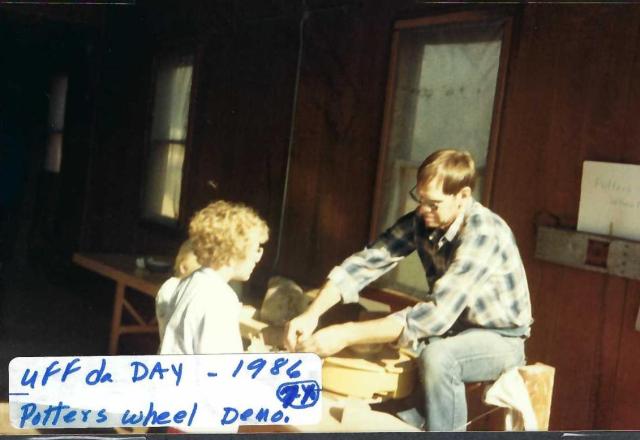
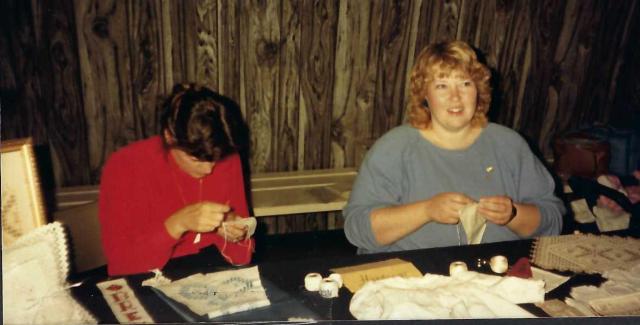
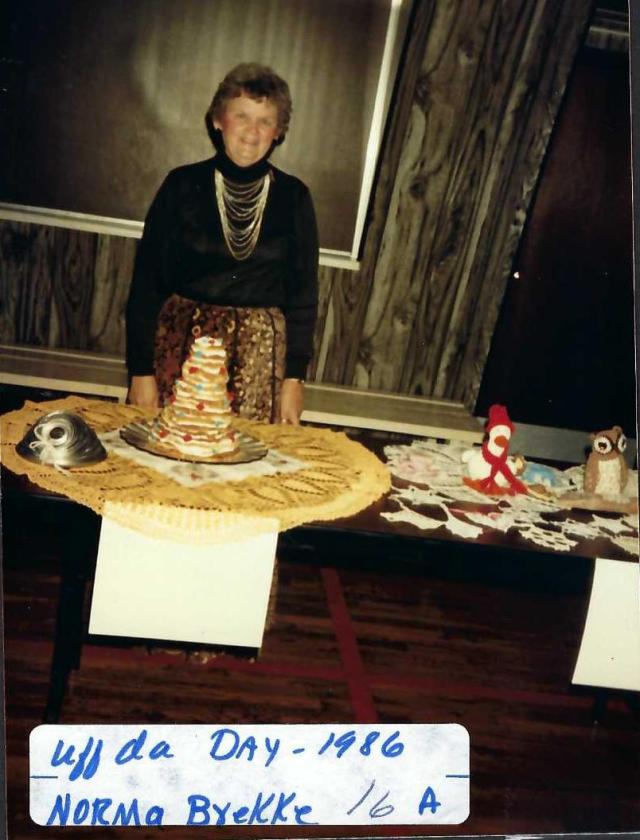
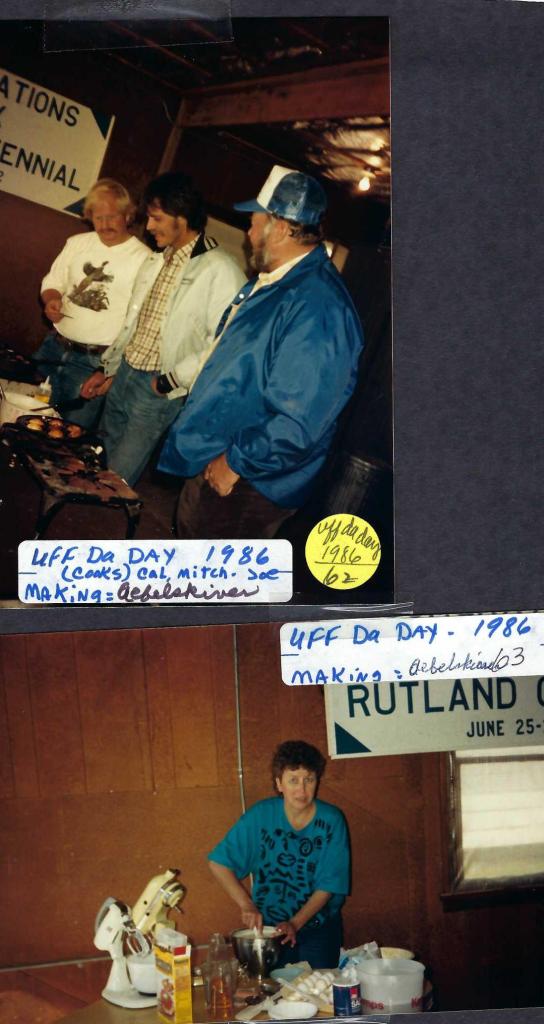
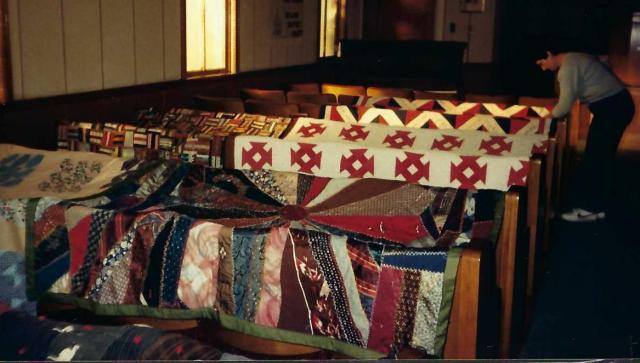
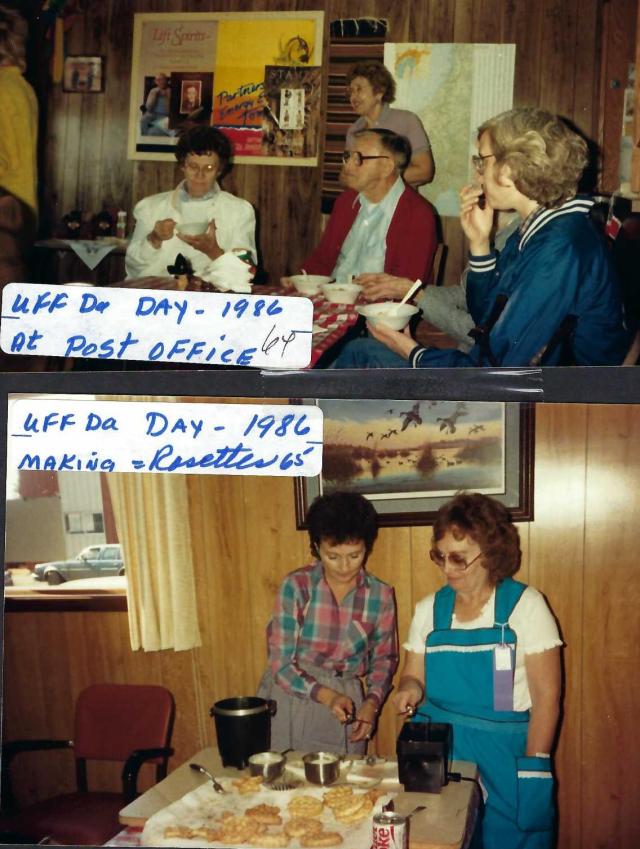
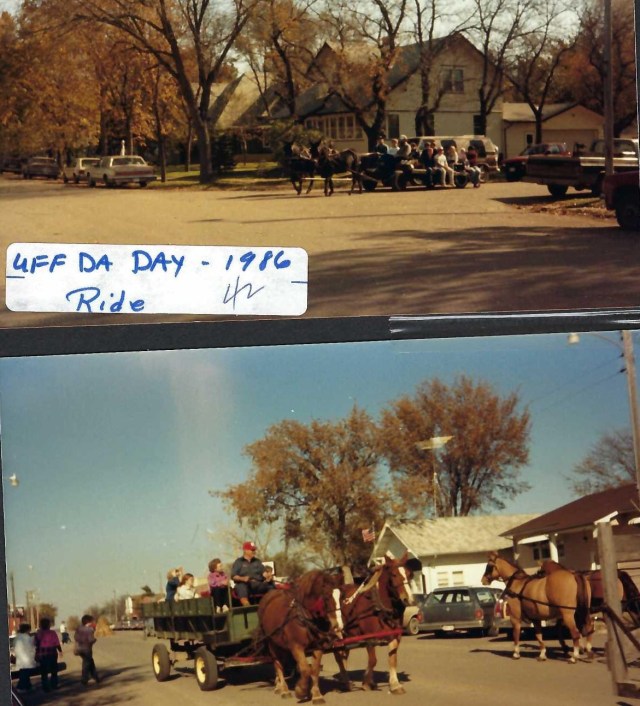
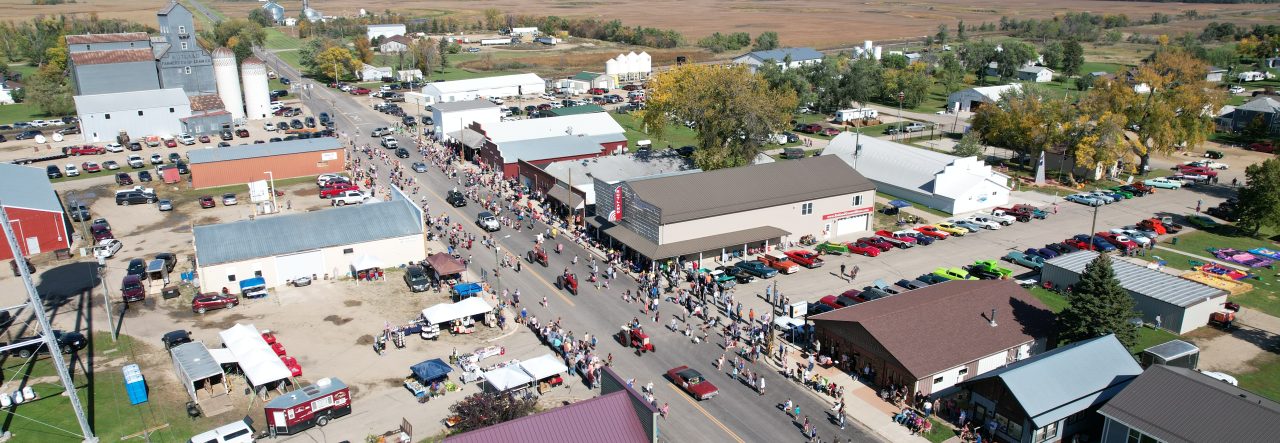
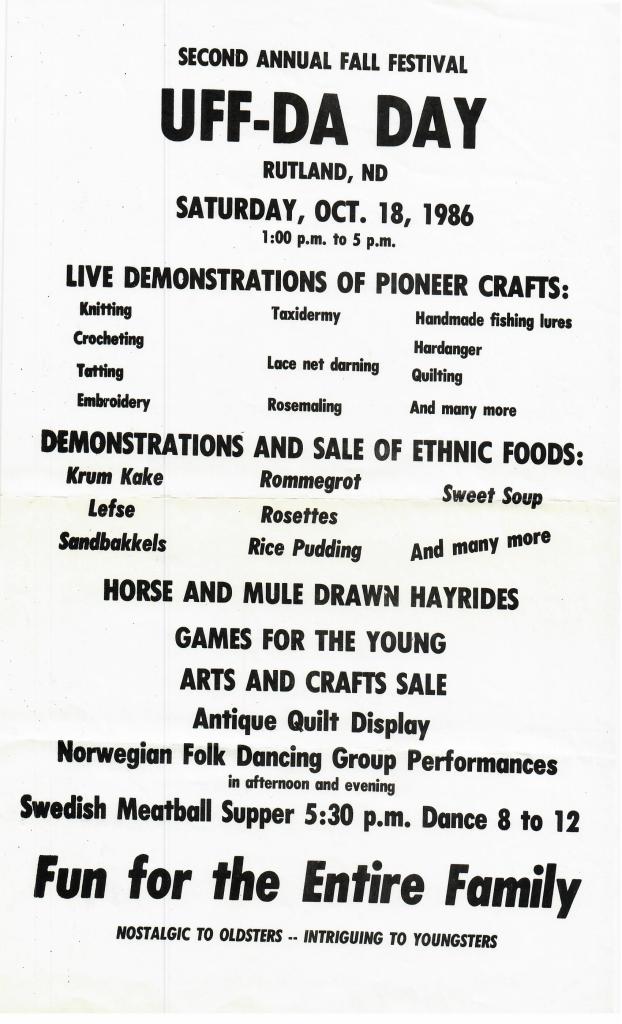
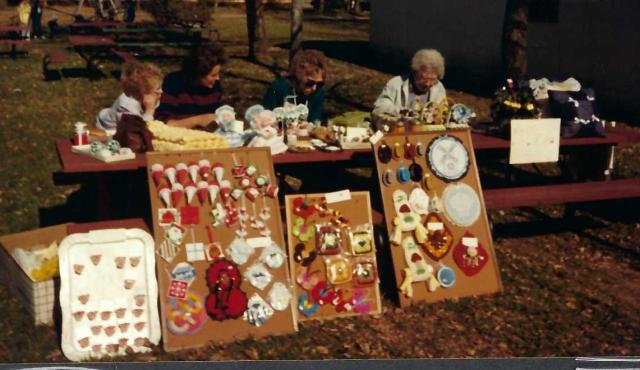
In March of 1986, the Rutland Community Club (RCC) designated the second Saturday in October of each year for Uffda Day, committing to the event for years to come. The RCC now could plan further in advance instead of pulling the event together in two months as they did in 1985. The second annual Uffda Day was held October 18, 1986. Kickoff was, again, at 1 p.m. and for only four short hours crafters demonstrated their art and rides were a big hit. This year more food options were added including abelskievers for the first time. Rosettes were available at the Insurance building and rommegrot at the Post Office. Antique quilts were on display at the Baptist Church and antique machinery could be seen around town. A Scandinavian smorgasbord started at 5:30p.m. with advance tickets for the supper and dance for only $5.50. Those who missed out on advance tickets had to purchase tickets at the door $3.50 for the supper and $3.00 for the dance. The meal included Swedish meatballs, boiled potatoes, peas and carrots, sweet soup, a relish tray, rommegrot, lefse and “assorted Norwegian cookies”. A 25-member band and dance group from Norway, The Fjellklang Spelemannslag, was the evening entertainment with a concert followed by a dance.
The Burger is Back!

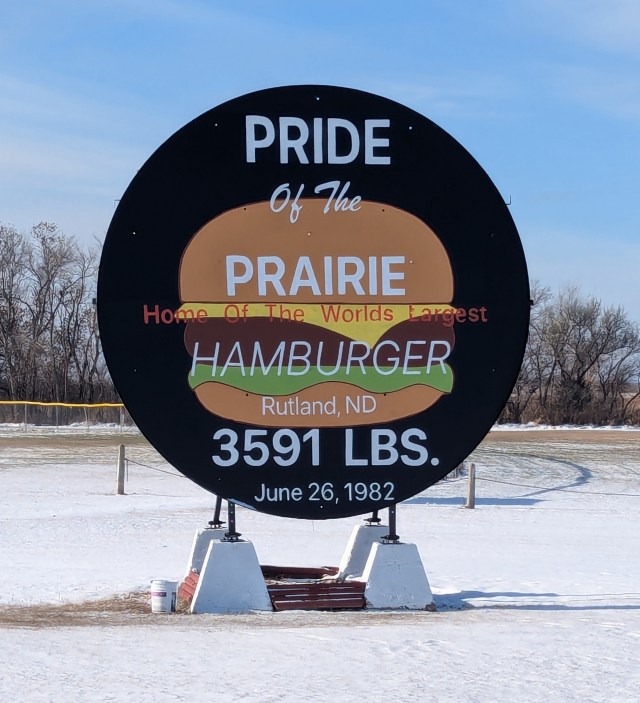
The burger is back. That’s right folks – and I’m not talking about the McDonald’s Quarter Pounder. The Rutland griddle is back in its glory with a fresh coat of paint after spending most of 2024 as a plain black canvas. The first time the grill was painted was in 1985 when one side of the grill was erected at Sanderson Field, and it has been repainted several times. The Rutland Community Club had been working with a local printer to make a canvas to cover the grill as a more permanent solution, but that option fell through. The Community Club found a rostered artist with the ND Council on the Arts who was available to do the work. Marcus Tracy, a visual artist, muralist and teaching artist, spent only a few days in Rutland to complete the burger painting.

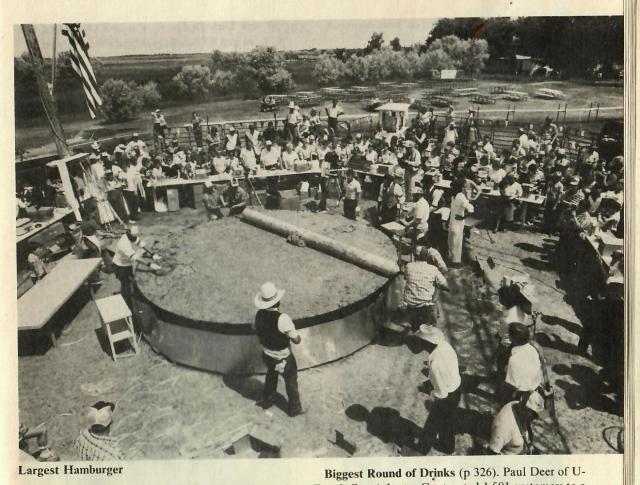
The Rutland grill at Sanderson Field is one-half of the skillet used to fry the (then) World’s Largest Hamburger in 1982. Each half of the skillet weighed more than a ton and had 201 square feet of grill space. The hamburger itself was 2½” thick and weighed 3,591 lbs. (raw). A homemade burner was used to cook the meat, and it was rolled flat with a 20-ft rolling pin that was also made by Rutland residents. Turning the burger was not a simple job. An identical plate was lowered by crane to the top of the burger, secured, and the burger was turned by crane and the upper plate removed. It took about two and one-half hours to cook the burger that was served to nearly 10,000 people. Be sure to check out the Rutland Centennial video on the City of Rutland, ND, YouTube channel. The burger is featured at about 13:20 in the video feed.

On July 7, 1982, the Guinness Book of Records of London awarded a Record Certificate stating that the “Rutland Community Club of Rutland, North Dakota, USA did break the Largest Beefburger record with a weight of 3,591 lbs. and diameter 16 feet.” The 1983 Guinness Book of World Records, p.325, still listed the Largest Hamburger (made of beef) on record of 3,020 lb. served in 13,083 portions in City Park, Towner, “Cattle Capitol of North Dakota” on June 18, 1981. However, in the Newly Verified Records section at the end of the book listed the “Largest Hamburger. A weight of 3,591 lb was registered for a hamburger 16 ft in diameter and 2½ in thick, made by the Community Club of Rutland, ND.”

There have been other hamburger records since then and even one flipped hamburger in Coral Springs, Florida, in 1988 when they cooked a 5,100 lb. burger on a 40-foot grill (comprised of 8-ft. sections) and firefighters used a crane to turn it one piece at a time onto smaller grills. That event was BYOB (bring your own buns). In my opinion, if they had a category for a flipped hamburger, Rutland would still hold the record!

The Dray Line

Here is a little bit of Rutland history for your enjoyment until we get another installment of the Rooster Crows.

THE DRAY LINE

In the grey dawn, Oscar Hoflen climbed to the spring seat atop his dray wagon and ordered his team of large draft horses to “Giddap”. The two Percherons, Pride and Bess, easily pulled the heavily loaded wagon away from the freight house door on the north side of the Rutland Depot. Oscar swung his team and wagon south on Main Street to begin delivering the freight which had arrived during the night to the businesses in town. Most mornings several loads awaited the dray man when he slid open the freight house door. When the freight had been delivered there would be coal to haul. It was hard work, but good horses and a strong back would see the job through. 1924 was the height of the railroad age, but it still took men and horses to move the goods to and from the rails.

The dray line was a business separate from the railroad. The dray line operator, called the drayman, contracted with local businesses to haul their freight to and from the depot for a fee. Otto Anderson, who had come to Rutland from Norway in 1901, operated the dray line during the early years of the century. Later, Irving Preble and his brother owned the business. Oscar Hoflen recalls that his brother, George, purchased the dray business in Rutland from Lars Holen shortly after World War I. George operated a line for a while and hired Oscar to assist him. In 1924 George purchased the Rutland Meat Market and sold the dray line to Oscar. For $1,800.00 Oscar purchased three wagons, three teams, three teams sets of harness and one Model “T” truck.

In those days the freight trains came through Rutland at night. The Westbound freight arrived about 10PM and the eastbound freight arrived about 2AM. Goods destined for Rutland would be transferred from the boxcars to freight wagons and pulled into the freight house where they would await the drayman. The drayman would begin delivering by 5 or 6 AM so the freight could be at the business places by opening time. Everything from whiskey to watermelons and panties to pianos came in on the train so there was a lot of freight to move. The businesses paid the drayman every week based on the weight of the freight which he had hauled for them.

Another job of the drayman was to deliver coal. Most homes were heated by coal then. Coal was handled by both the lumberyard and the elevator. The elevator sold most. The delivery charge for coal was $1.00 per ton.

Rutland Depot Jumps the Tracks

Adapted from an article originally written in 2008

For 100 years the Great Northern, later the Burlington Northern, depot had occupied the same location, north of the tracks and east of First Street, in Rutland. On June 1, 1987, a moving crew, commanded by Nick Schmidt, Wyndmere, picked the building up and moved it to new location one block south on the corner of First and Arthur Street, in Rutland. The depot now faces east. Once the center for commerce and information in the community, the 28′ X 60′ structure is now used as a Heritage Center for the Rutland community, “The Depot Museum.”

In 1886 the Great Northern Railroad laid track as far west as Rutland. The following year the Railroad was extended southwest to Aberdeen, and west, to Ellendale. During this year the Great Northern had a complex of buildings, including the depot, a water tower, coal dock, roundhouse and section house, constructed in Rutland to service its equipment and serve its customers. The business of the railroad was to move freight and the east half of the depot was a freight warehouse. The west half was a passenger waiting room. The office was located between the freight house and waiting room. Telegraph operators were on duty round the clock to send and receive messages and to relay messages to stations on the Aberdeen and Ellendale lines. Two freight trains and two passenger trains stopped in Rutland each day on the Aberdeen line. Another train originated in Rutland and made a round trip to Ellendale each day. The Ellendale line was extended to Forbes, N. D. in 1905 and was known as the Forbes line thereafter.

Mr. Bagley was the Great Northern’s first agent in Rutland. He gave his name to one of Rutland’s streets and is said to have contributed the name of his home town, Rutland, Vermont, to the new village on the prairie. At that time the agent’s pay was partly based on the volume of business transacted at his station. Because Rutland was a junction point and the station was open 24 hours a day, 7 days a week, the business volume was greater than at other stations and the pay was correspondingly higher. Although this system was changed in later years it made the agent’s job a desirable one in the early days.

Continue reading “Rutland Depot Jumps the Tracks”

The Rooster Crows – Sept. 24, 2021

By Bill Anderson

September hesitated on its way to Autumn last weekend, when the temperature soared into the upper 80’s, with the humidity following suit, on Saturday & Sunday, September 18 & 19. Local mosquitoes thought that they might have a chance for a good season, after all, but their fantasies were foiled by a 35 degree plunge in temperature on Monday morning. Monday’s conditions wrung some moisture out of the air, resulting in a day long drizzle that left .2 of an inch of precipitation in Rutland, according to Roger Pearson’s rain gauge, and .4 of an inch of precipitation according to the rain gauge of Roger’s next door neighbor, Norbert Kulzer. As of Tuesday, September 21, the forecast is calling for pleasant, early Autumn weather through Uff-Da Day, Sunday, October 3. Cross your fingers!

Miss Lauren Kulzer of Kansas City MO visited at the home of her grandparents, Norbert & Beverly Kulzer, from Friday, September 10 through Sunday, September 12. Lauren is the eldest daughter of Stephen & Ann Kulzer of Hartford SD, near Sioux Falls. She is a graduate of South Dakota State University in Brookings SD, and is currently employed as an RN in a large hospital in Kansas City. As the old song goes, “Everything’s up to date in Kansas City.” Despite its modern advantages, though, Kansas City can’t compare to Grandpa & Grandma’s home in Rutland, or to Grandma’s home cooking.

Kevin Oland of rural Geneseo reports that a Marboe Township Reunion was held on Saturday, September 18. The Township is situated in the southeastern corner of Sargent County, and is south of the northern boundary of the Wahpeton-Sisseton Reservation and north of the North Dakota State Line. According to reunion organizer Carol Anderson, 60 current and former Township residents registered for the event, including 40 Alumni of Marboe Township’s 1 room country schools. The Wood Lake School building is the only one of the Marboe Township school buildings that remains at its original location. One of the Marboe Township school buildings is now part of an exhibit of structures from early Norwegian settlements in America on the island of Radoy in Norway. Carol Anderson is the daughter of the late Edwin and Fern Anderson of Marboe Township. Her grandparents homesteaded in Marboe Township, and Kevin Oland now owns and resides on the original Anderson homestead.

Continue reading “The Rooster Crows – Sept. 24, 2021”

The Rooster Crows – Sept. 3, 2021

By Bill Anderson

The drought is not yet broken, but it was seriously bent and dented during 8 days NEAR THE END of August. Depending on whose rain gauge you want to believe, Rutland and vicinity received between 3” and 3½” of rain from Friday, August 20 to Saturday, August 28, restoring green to the grass and hope to the hearts of local corn and soybean growers. The meteorologists on TV and radio are telling us that we are still 12” to 13” short of precipitation for the year, though. In the event that the precipitation shortfall is made up in snowfall this coming winter, we are looking at about 12 feet of snow just to get back to “normal,” whatever that is. Here in Rutland, we’re still praying for rain, but keeping the snow shovel handy.

A crew from Morris Seal Coat of Morris MN took advantage of the hot, dry conditions that prevailed prior to August 20 to apply a seal coat of oil and chips to 15 miles of County Road #10 and County Road #7 near Rutland and Havana. The sections of road in this area that received the treatment included the 3 miles from ND Highway #11 north to the intersection with County #10A; the 7 miles of County #10 from Rutland south to the intersection with County #7; and, the 5 miles of County #7 from the intersection with County #10 through Havana to ND Highway #32. Several other sections of Sargent County roads were also slated to receive seal coats, according to County Road Commissioner Jason Arth. The seal coat is intended to preserve the existing pavement and extend its life for another 7 to 10 years. Several other sections of County roads, such as #10 south from ND Highway #11 through Rutland; and, County #12 from ND Highway #11 at Cayuga to ND Highway #13; are in line for new pavement overlays, but those projects have to wait for funding from the Federal Government’s new infrastructure bill. The seal coat projects now underway and recently completed were paid for with funds from the existing Federal Aid program and matching money from the County’s Federal Aid Roads mill levy. Sargent County’s annual allotment was not sufficient to pay for the current seal coat projects, but the program does allow counties to borrow ahead if funds are available and to repay the borrowing, at no interest, with future allocations.

Rutland Community Club President Katie McLaen reports that preparations for Uff-Da Day XXXVI on Sunday, October 3, are progressing well. According to Katie, Lefse Lena has 2 more lefse making sessions scheduled: at 6:00 p.m. on Thursday, September 9; and, at 6:00 p.m. on Tuesday, September 14. Both sessions will be in the kitchen of the Rutland Town Hall. Anyone who wants to practice their lefse making skills, or who wants to learn just how lefse is made, is welcome to participate. Just give Katie McLaen a call, or show up at the Rutland Town Hall on Thursday, September 9 and Tuesday, September 14.

Continue reading “The Rooster Crows – Sept. 3, 2021”